Yoshitomo Nara’s pop culture aesthetic may appear whimsical at first but there’s an urgent call for change embedded in his work, writes Craig McKeough.
Reviews/Visual Art
Pop star artist makes powerful plea for peace
27 March 2023

- Reading time • 6 minutesVisual Art
More like this
- A walk with Tina Stefanou
- A blaze of glorious people
- Diving into the gothic world of Erin Coates
Reach Out To the Moon, Even If We Can’t, Yoshitomo Nara
Art Gallery of Western Australia
Yoshitomo Nara is a pop star in the international art world, his cartoon-like creations tapping into a highly accessible youth culture realm, and his imagery heavily merchandised on everything from hats and t-shirts to luggage tags and stickers.
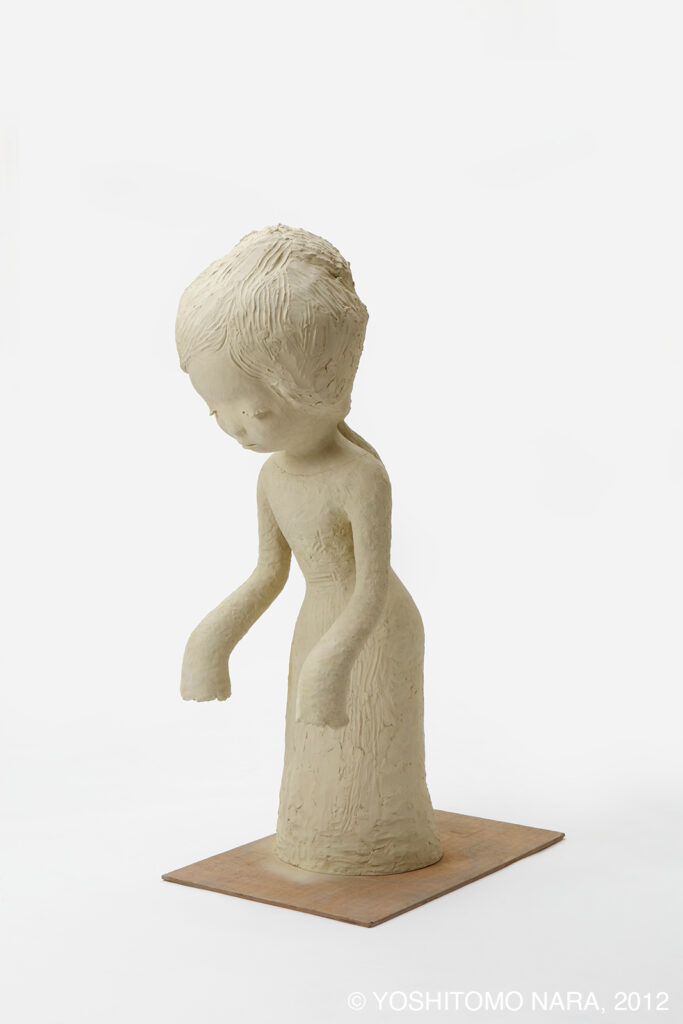
It is no surprise that the Art Gallery of WA’s success in securing this collection of the Japanese master’s work from the past decade has captured significant attention. On the day I visit, there is a big crowd of young people wandering through the ground floor space, taking selfies with the artworks – a welcome but unfortunately not so common sight in the gallery.
Nara’s signature style is very much Japanese, with influences as wide as Edo and anime. This is in evidence in all the large-scale sculptural pieces and complementary works on the walls, some of them working drawings for the three-dimensional pieces.
The big bulky heads in polymer clay dominate the room, with their surface bearing the marks of Nara’s hands and tracing his efforts to push and form the material. The addition of what might be seen as rudimentary facial features, hallmarks of Nara’s simple, almost naive, style, transforms the raw material into figures with individual character and purpose.
They share a sad solemnity, in particular the smaller scale Thinking Sister, which bears a kind of melancholic wisdom, and the matching pair of full figure works, Midnight Pilgrim, which seem to carry the weight of the world’s worries on their slender shoulders.
The drawings and paintings, many of them seemingly spontaneous creations on old envelopes and scrap paper, display more of Nara’s feisty characters, most of them young girls, who are united in expressing an anti-war sentiment.
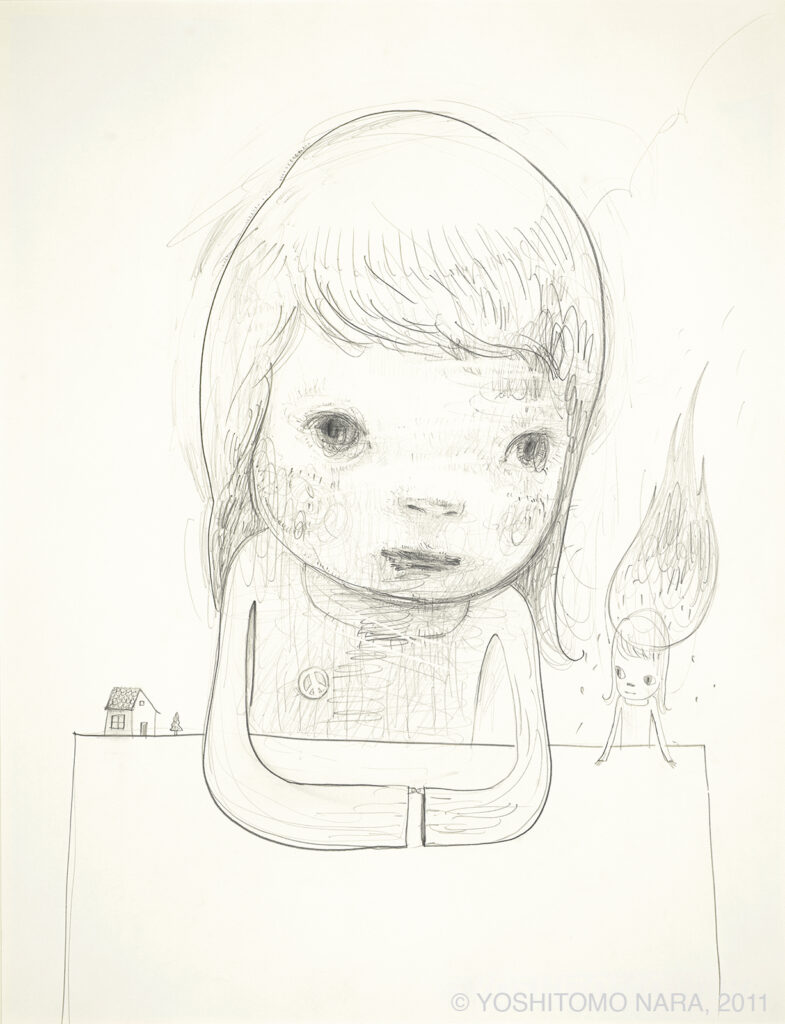
Their strength and defiance is apparent but there are also signs of vulnerability, portrayed in one of the highlights of the collection, Headache, a deftly rendered pencil drawing which neatly captures the conflicting forces and influences at play in the adolescent mind – yes, we need to place our hope for the future in our young people but don’t forgot the toll that the multitude of contemporary threats and stresses takes on them.
One of those threats which actually turned into reality – the Fukushima nuclear disaster in 2011 – is a strong theme running through this collection. The immense tragedy of the earthquake, tsunami and nuclear accident shook Nara’s creative impulse to the extent that he couldn’t work at all for some time. It was through the opportunity to work with his hands on the large clay sculptures that he found his way back to his art.
His trio of photographs of Ukedo Elementary School is particularly poignant and pointed in the context of Fukushima. The images of an abandoned classroom where time stopped and up to 150 lives were lost provide a compelling context for the rest of the exhibition. The characters in the drawings that in isolation seem quirky and humorous – like angsty Powerpuff Girls – suddenly take on more urgency.
They are the witnesses to all that has gone wrong, the young ghosts of Fukushima.
We can now see them as issuing a call to us, a plea for a desperately needed change of course from war to peace, something that it appears only the young can see.
Pictured top: Nara’s feisty characters, most of them young girls, who are united in expressing an anti-war sentiment. Yoshitomo Nara, ‘Mini drawing’ 2016, coloured pencil and ballpoint pen on paper, 11.5 x 9.7 cm. On loan from the Artist, courtesy Pace Gallery, ©YOSHITOMO NARA, 2016
Like what you're reading? Support Seesaw.

Past Articles
Isolation no obstacle for artists
Over the last three years the Mycelium project has presented 12 exhibitions, one in every region of WA. The culmination of this project, Open Borders, celebrates the creative energy of our regional artists, says Craig McKeough.
Take a trip down memory lane
You’ll find plenty to spark memories of your own in Placemarks, an exhibition that sees artists explore far flung places from childhood, former homes and old haunts in the suburbs.